
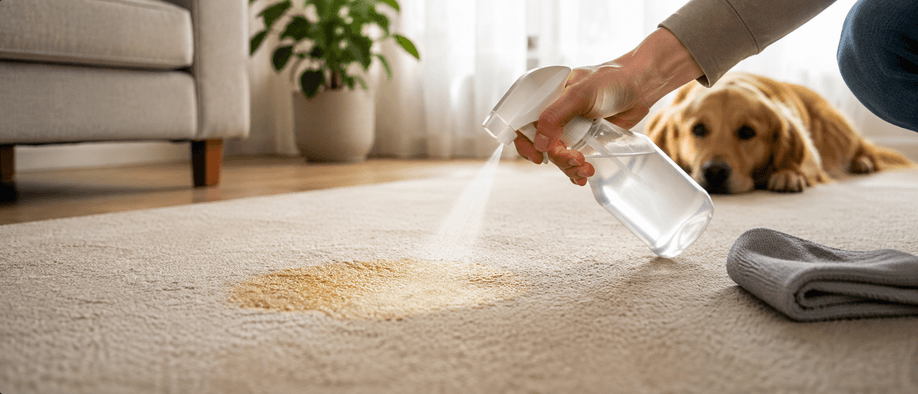
How to Remove Pet Urine Smell From Your Home
Key takeaways
- Cleaning the visible spot is not the same as removing the smell. Urine soaks into cushion foam, carpet padding, rug backing, and grout, and the odor comes back once that hidden reservoir gets damp again.
- The right method depends on the surface. What works on carpet can damage upholstery, and what works on tile can be wrong for grout. Match the treatment to the material.
- Old, deep, or recurring odor usually needs professional extraction. Once urine reaches the padding or foam layer, surface cleaners cannot fully reach it. Pro Care Texas offers a free in-home assessment across Fort Worth and DFW.
You cleaned the spot. You cannot smell it standing up. Then you walk back into the room an hour later, or the humidity climbs, and the odor is right back. That is the most common complaint we hear about pet accidents, and it almost always means the urine reached something deeper than the surface you wiped down.
This guide covers why pet urine odor lingers, how to find where it is actually coming from, and how to treat it correctly across upholstery, rugs, carpet, mattresses, pet beds, tile, grout, and hard floors. It also covers when DIY cleaning has done all it can do, and a professional extraction is the faster, more reliable path.
Why does pet urine smell linger?
Pet urine contains uric acid, which forms crystals that bond tightly to fibers, backing, padding, and grout. These crystals are not water soluble, so ordinary cleaning products can lift the surface stain and smell temporarily while leaving the crystals behind. Cleaning experts note that these uric acid salt crystals attach strongly to carpet fibers, backing, padding, and subflooring, and that standard cleaners cannot dissolve them, which is why the odor resurfaces once humidity or moisture reaches the residue again (source: cleaning expert Sofia Martinez, CEO of Sparkly Maid Austin).
That is why the smell fades right after cleaning, then reappears on a humid day or after the area gets damp again. It is also why repeated accidents in the same spot, or urine that has had time to dry and soak in, are harder to fully clear than a fresh spill you catch and treat right away.
Finding where the smell is coming from
Before you treat anything, find the actual source. Odor can travel, so the smell in a room is not always coming from where you think.
Check these areas:
- Couches, chairs, and other upholstered furniture, including under cushions
- Rugs and carpet, especially edges, corners, and seams
- Under rugs and under furniture legs
- Carpet padding beneath heavily soiled carpet areas
- Baseboards and where flooring meets the wall
- Mattresses and pet beds
- Tile grout lines near litter boxes, pet doors, or feeding areas
A UV or black light can help reveal older, dried stains that are not visible in normal light, though it is not foolproof on every surface or every pet. Think of it as one tool among several, not a guarantee you have found everything.
How to remove pet urine smell from upholstery
Sofas, couches, recliners, armchairs, ottomans, and dining chair cushions all need the same first step: check the upholstery cleaning code on the furniture tag before using anything. A “W” label means water-based cleaning agents are safe, an “S” label means dry-cleaning solvents are the safer route, “W/S” allows either, and an “X” label means vacuuming only.
- Blot fresh urine right away with a clean, dry cloth. Do not rub.
- Vacuum loose dirt and pet hair from the area.
- Use a cleaner rated for the fabric’s code (water-based for W, solvent for S).
- Apply an enzyme-based pet odor treatment appropriate for upholstery, not a carpet-only product.
- Avoid oversaturating the cushion. Blot out excess moisture and let it air dry fully.
If urine has reached the foam inside the cushion, surface treatment usually is not enough. Foam holds onto both moisture and odor, and that layer is where professional upholstery cleaning makes the real difference.
How to remove pet urine smell from rugs and carpet
The same principles apply to area rugs, wall-to-wall carpet, runners, and carpeted stairs, because the way urine moves through the fibers is similar.
A fresh accident on the carpet surface is a different problem than urine that has already reached the padding or the rug backing. If you blotted it quickly and it never fully soaked through, an enzyme cleaner applied to the surface may fully resolve it. If the spot has been there for a while, or you can feel dampness when you press on it, assume it has gone deeper.
Some rugs, especially wool, natural fiber, or antique pieces, need gentler handling than synthetic carpet. When in doubt, treat a valuable rug the way you would treat a delicate upholstery fabric rather than a synthetic carpet. Our carpet cleaning and area rug care teams use different extraction methods for exactly this reason.
What about mattresses and pet beds?
Mattresses: Blot fresh accidents immediately and avoid soaking the surface. Follow the care instructions for your specific mattress cover or fabric, and make sure the area dries completely before the bed is used again. A mattress that stays damp underneath the sheets is a setup for lingering odor and mold.
Pet beds: Check the washing instructions first. Removable covers can usually be laundered on their own, but the inner filling may need separate treatment if urine soaked all the way through. Do not let a pet bed back into use until it is fully dry.
How to clean pet urine from tile and grout
Tile itself is usually easy to wipe clean, but grout is a different story. Grout sits slightly lower than tile and is porous by nature, which makes it especially prone to trapping dirt, spills, and moisture. That same porosity is why grout can hold onto pet urine and odor long after the tile surface looks clean.
Focus on grout lines and edges near litter boxes, pet doors, and feeding areas. Use a cleaner made for grout rather than a general all-purpose spray, since some products can discolor or wear down grout over time. If the odor persists after cleaning, the grout may need a deeper treatment than a mop-and-bucket job can provide.
Can pet urine damage hardwood and other hard floors?
Hardwood, laminate, vinyl, and concrete each respond differently to pet accidents, so there is no single method that works for all of them.
- Hardwood is the most vulnerable to moisture. Urine that sits too long can seep into seams between boards and cause staining or warping.
- Laminate and vinyl resist surface moisture better, but urine can still work into seams and edges if it is not cleaned up quickly.
- Concrete is porous and can absorb odor over time, particularly in garages or unsealed slabs.
In all four cases, speed matters more than the specific product. The longer urine sits, the more likely it is to reach a seam, crack, or porous spot underneath the visible surface.
Choosing the right cleaner for pet urine
Not every pet-odor product does the same job.
| Type | What it does | Best for |
|---|---|---|
| Enzyme-based cleaner | Breaks down uric acid crystals at the source | Fresh to moderately set stains on fabric, carpet, grout |
| General carpet/upholstery cleaner | Lifts surface dirt and stains | Everyday soil, not odor at the source |
| Odor-masking spray | Covers the smell temporarily | Short-term freshening only |
| Surface disinfectant | Sanitizes, does not target uric acid | Hard surfaces, paired with an enzyme step |
Always check that a product is rated for the surface you are using it on. A cleaner formulated for carpet is not automatically safe for upholstery, hardwood, or grout, and mixing different cleaning chemicals together can create a worse problem than the odor itself.
What not to do when cleaning pet urine
- Do not scrub fresh urine. It pushes the stain deeper into the fibers.
- Do not oversaturate carpet or upholstery with cleaner or water.
- Do not ignore the padding or cushion foam underneath a treated surface.
- Do not use a cleaner without checking it is safe for that material.
- Do not mix cleaning products together.
- Do not rely on fragrance alone to cover the smell.
- Do not leave a damp area without airflow to help it dry.
- Do not assume steam or heat is safe for every fabric or floor.
Why does the smell keep coming back?
If you have cleaned the spot and the odor still returns, one of these is usually the reason:
- The original treatment did not fully reach the uric acid, only the surface stain
- Urine soaked into padding, foam, or subfloor below what you treated
- There is a second accident spot nearby that has not been found yet
- A neighboring rug, cushion, or baseboard picked up some of the odor
- The area was cleaned but never fully dried
- The smell is actually coming from underneath a rug or piece of furniture, not the visible surface
Chasing the smell with more air freshener will not fix any of these. Finding the actual source and treating it properly is the only thing that works long term.
How to prevent pet urine smell from coming back
- Clean accidents as soon as you find them, not at the end of the day.
- Vacuum rugs and upholstery on a regular schedule to reduce buildup.
- Wash pet bedding regularly, including removable covers.
- Pay extra attention to any spot where an accident has happened before, since pets often return to the same area.
- Check nearby rugs and carpet if an odor persists, since it may have spread further than the original spot.
- Keep a treated area off-limits to pets and foot traffic until it is completely dry.
- Stay on a regular maintenance schedule for carpet, rugs, and upholstery rather than waiting for a problem to show up.
When is it time to call a professional?
DIY cleaning handles a lot of pet accidents just fine. It is time to call in a professional when:
- The smell keeps returning after you have cleaned it more than once
- Urine has clearly reached the carpet padding or cushion foam
- More than one area of the home is affected
- The stain or accident is old and has had time to fully dry and set
- The material is delicate, like wool rugs or certain upholstery fabrics
- You are not sure which cleaning method is safe for the surface
- There is visible staining or discoloration that home cleaning has not lifted
What can affect the results
Every situation is different, and a few things shape how much a cleaning, DIY or professional, can realistically achieve: how old the urine is, how deep it penetrated, the material involved, how many accidents have happened in the same spot, whether there is padding or foam construction underneath, and any previous cleaning attempts (some at-home products can actually make extraction harder later). No cleaner, home or professional, can promise 100 percent odor removal in every case, but professional extraction reaches layers that surface cleaning cannot, which is why it succeeds where repeated DIY attempts have not.
Pro Care Texas handles pet odor remediation alongside upholstery, carpet, rug, and tile and grout cleaning for homes across Fort Worth, Keller, Haslet, and the surrounding DFW area. If DIY cleaning has not fully solved it, a free in-home assessment can tell you exactly what is going on and what it will take to fix it.
Getting rid of pet urine smell for good
Lingering pet urine odor almost always means the smell has reached somewhere your cleaning did not, whether that is cushion foam, carpet padding, rug backing, or porous grout. Find the actual source before you treat anything, match your cleaning method to the specific surface, and use an enzyme-based product rather than one that only masks the smell. If the odor keeps coming back after a real effort to treat it, or you know it has reached padding or foam, professional cleaning is usually the fastest way to actually remove it instead of just covering it up.
If you are dealing with a pet odor that will not quit, call or text (817) 845-1595 or request a free in-home quote and let Pro Care Texas find the source and clear it for good.
Get your free pet odor assessment
Frequently Asked Questions
Why does my house smell like pet urine even after I clean it?
The smell almost always means urine reached below the surface, into cushion foam, carpet padding, rug backing, or grout. Ordinary cleaners lift the visible stain but cannot reach the uric acid crystals trapped deeper, so the odor returns once the area gets damp again.
Does vinegar get rid of pet urine smell?
Vinegar can help with the surface stain and some odor, but it does not break down uric acid crystals the way an enzyme cleaner does. For a fresh, minor accident it may be enough, but for anything that has soaked in or dried, an enzyme-based product works better.
Can pet urine smell be permanently removed?
In most cases, yes, especially with enzyme treatment and, when needed, professional extraction. Very old or heavily saturated padding, foam, or subfloor may need replacement rather than cleaning if the smell has been present for a long time.
How do I know if the smell is coming from the carpet padding?
If the surface looks and smells clean right after treatment but the odor returns, especially in humid weather, that usually points to padding underneath rather than the visible carpet fibers.
Is it safe to use a black light to find pet stains?
Yes, a UV or black light can reveal dried urine that is not visible in normal light. It is a useful tool for locating stains but is not perfect on every surface, so use it alongside a normal visual and smell check rather than relying on it alone.
Can pet urine ruin hardwood floors?
Yes, if it sits too long. Urine can seep into the seams between boards and cause staining, discoloration, or warping. Cleaning it up quickly is the most important factor, more than which specific product you use.