
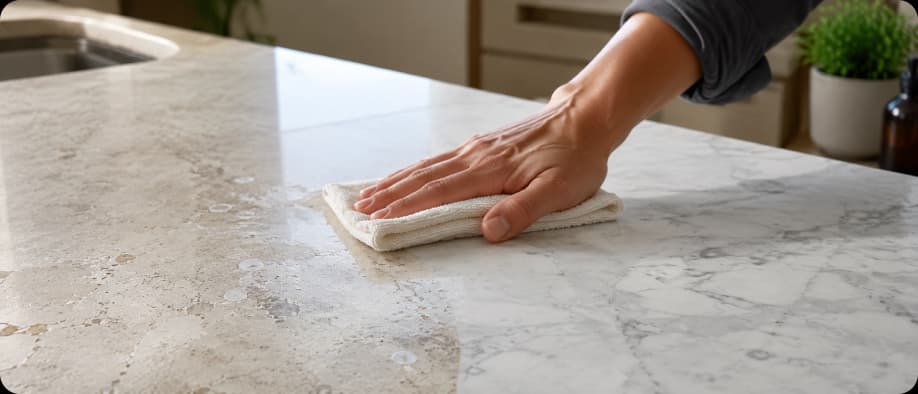
How to Remove Marble Stains, Etch Marks, and Water Spots From Natural Stone
Key takeaways
- A stain soaks into the stone and can often be pulled back out with a poultice. Etching is surface damage that only honing and polishing can fix, not cleaning.
- Never use vinegar, lemon, or generic cleaners on marble, travertine, or limestone. They cause the etching you are trying to avoid.
- Dull or etched marble, and any countertop or floor, is best restored by a pro. Pro Care Texas offers a free in-home stone assessment across Fort Worth and DFW.
Natural stone looks incredible, but it is porous and reactive, which is why a marble countertop or travertine floor can turn cloudy, spotted, or dull after a few years of normal use. The good news: almost everything people call a “stain” falls into a few predictable categories, and each one has a known fix. Some you can handle at home in an afternoon. Others, especially etching and lost shine on marble, need professional honing and polishing to truly correct.
This guide explains what is actually happening to your stone, what you can safely do yourself, and when it pays to bring in a pro. It comes from more than 20 years of restoring marble, granite, travertine, and limestone in homes across Fort Worth, Keller, Haslet, and the wider DFW area.
First, know the difference: stain vs. etch vs. water spot
This is the single most useful thing to understand, because it decides the entire fix. In our experience across DFW homes, the two calls we get most often are hard-water etching around kitchen sinks and dull rings on bathroom vanities, and both are etching, not staining, which is why cleaners never fixed them.
| Type | What it is | How to spot it | The fix |
|---|---|---|---|
| Stain | A liquid (coffee, oil, wine, rust) soaked into the pores and left color behind | Surface still feels smooth; it is a color change that sits in the stone | Draw it out with a poultice |
| Etch | An acid reacted with the calcium in the stone and dissolved a little of the surface | A dull, lighter, sometimes rough spot or ring; a change in texture | Honing and polishing (no cleaner can fix it) |
| Water spot | Hard-water minerals on top, or light etching from water sitting too long | Cloudy or dull marks near faucets, vanities, and showers | Stone-safe cleaning, or polishing if it has etched |
A 5-second test: run a finger over the mark. If it feels smooth and it is just a color change, you are probably dealing with a stain. If it feels slightly rough, or it looks dull and lighter when light hits it at an angle, that is etching.
Which stones etch matters too, because it tells you how careful to be:
| Stone | Etches from acid? | Care level |
|---|---|---|
| Marble, travertine, limestone, onyx | Yes (calcium based) | High: no acids, seal regularly |
| Granite, quartzite | Rarely | Lower: still seal, but far more forgiving |
How to remove common stone stains yourself
For minor, fresh stains on sealed stone, you can often take care of it at home. Two rules first: never use anything acidic (no vinegar, no lemon, no CLR, no generic bathroom or tile cleaner) on marble, travertine, or limestone, and never use abrasive pads. Both cause the exact etching you are trying to avoid.
Hard-water spots and mineral buildup
Wipe with warm water and a few drops of dish soap, or a cleaner labeled safe for natural stone. For crusty buildup around faucets, lay a stone-safe cleaner on it for a few minutes to soften, then work it gently with a soft cloth or a plastic (not metal) scraper. Buff dry so new spots do not form. Skip the vinegar and lime-scale products; on calcium stone they trade a water spot for an etch.
Organic stains (coffee, tea, wine, food)
These respond well to a hydrogen peroxide poultice:
- Mix 12% hydrogen peroxide with a little baking soda into a thick paste.
- Spread it about a quarter inch thick over the stain.
- Cover with plastic wrap and tape the edges.
- Leave it 24 to 48 hours, then remove and rinse.
- Repeat if the stain faded but did not fully clear.
Oil-based stains (grease, cooking oil, lotions, cosmetics)
Oil needs to be pulled out, not wiped off. Use the same poultice method, but make the paste with baking soda and water. Cover, wait 24 to 48 hours, and the powder draws the oil up as it dries.
Rust stains (cans, metal furniture, iron in water)
Rust is stubborn and rust removers made for other surfaces will etch stone. There are rust poultices made specifically for natural stone, but deep or spreading rust usually needs a professional. If it keeps coming back, the iron may be inside the stone itself, which is a pro job.
Why you cannot “clean” etching or dullness off marble
Here is where a lot of people waste money on cleaners that were never going to work. Etch marks, water rings, and the overall loss of shine on a marble top are not dirt. They are damage to the surface itself. The only real fix is mechanical: honing to level the surface and remove the etching and light scratches, then polishing with progressively finer diamond abrasives to bring back clarity and reflection.
Done well, the repaired area disappears into the rest of the stone. Done wrong, it leaves swirl marks, haze, or an uneven sheen that is very obvious under kitchen or bathroom lighting. This is skilled work, and it is exactly the kind of job where a professional saves you the cost of making it worse.
When it is time to call a professional
- Etch marks, rings, or dull spots on marble or other polished stone
- Overall cloudiness or a countertop that has lost its shine
- Scratches, chips, or lippage (uneven tile edges that catch a toe or a mop)
- Large areas like floors, showers, and full countertops
- Any high-value stone: marble and quartzite counters, polished travertine, honed limestone
- Before listing a home, since restored stone photographs and shows far better
How professional natural stone restoration works
A full restoration follows four steps, and each one matters:
- Deep clean. A stone-safe, pH-neutral clean that lifts dirt and grime without acid.
- Hone. Diamond pads remove etching, water rings, and fine scratches and level the surface. This is what actually erases the damage.
- Polish. Progressively finer abrasives and polishing compound rebuild the clarity and shine, matching the original finish (polished, honed, or satin).
- Seal. A penetrating sealer soaks in to slow down future staining and buy you time to wipe up spills.
Timeframe depends on the job. A typical countertop is often a few hours. Larger floors, showers, and whole-home projects can run a day or more.
What affects the cost of natural stone restoration
Pricing tracks the work involved. Cleaning and sealing is the most affordable service because it is straightforward. Honing and polishing costs more because it is labor and skill intensive and it permanently repairs the surface. The final price of any job depends on the size of the area, the type and finish of the stone, and how much damage there is, so there is no one-size-fits-all rate. Floors, showers, and full countertops are best quoted after a quick in-home look, since condition varies so much.
The fairest way to get an accurate number is a free in-home assessment, where we can see the stone, test a small area, and give you an exact price before any work begins.
How to keep your stone looking new
- Seal it, and reseal on schedule. Most stone benefits from resealing every one to three years, sooner for busy kitchens.
- Wipe spills fast, especially anything acidic like citrus, wine, coffee, or tomato.
- Use coasters, trivets, and cutting boards. Do not set hot pans or acidic food straight on the stone.
- Clean with a pH-neutral, stone-safe product only. No vinegar, no lemon, no generic all-purpose or bathroom sprays.
- Dust-mop stone floors and skip the steam mop and acidic floor cleaners.
- Get a professional deep clean and reseal periodically to reset the protection and catch small issues early.
The natural stone we care for across Fort Worth and DFW
We clean, hone, polish, seal, and repair marble, granite, travertine, limestone, slate, and Saltillo, on countertops, floors, showers, vanities, fireplaces, and outdoor stone. Services include stone cleaning, honing, polishing, sealing, hole and chip filling, and scratch and etch removal. We are an owner-operated company based in Haslet, serving Fort Worth, Keller, Southlake, Aledo, Colleyville, and the surrounding communities.
Get a free stone assessment in Fort Worth
If your marble looks dull, your travertine is spotting, or your stone floors have lost their shine, we can bring them back. Tell us what you are dealing with and we will give you a clear, no-pressure price. Call or text (817) 845-1595 or request your free quote today, and let Pro Care Texas restore your natural stone.
Get your free stone assessment
Frequently Asked Questions
Can etching be removed from marble?
Yes, but not by cleaning. Etching is surface damage, so it is corrected by honing and polishing the stone, not by any spray or cleaner. A professional levels the etched area and rebuilds the finish so it blends in.
Does vinegar clean marble?
No. Vinegar is acidic and it etches marble, travertine, and limestone on contact, leaving dull spots. Use only a pH-neutral cleaner made for natural stone.
How do I get water stains off marble?
If it is hard-water buildup, clean gently with a stone-safe cleaner and buff dry. If the spot is dull and slightly rough, it is light etching and needs polishing rather than cleaning.
How often should natural stone be sealed?
For most homes, every one to three years, and more often for heavily used kitchen counters. A quick water test tells you: if water stops beading and soaks in, it is time to reseal.
Is granite easier to maintain than marble?
Yes. Granite is much more resistant to acid and etching, so it handles kitchen use better. Marble is softer and calcium based, so it needs more care and benefits most from professional polishing and sealing.
Can you fix a dull marble countertop?
Yes. Professional honing and polishing restores the shine and clarity on a dull or etched marble counter, and a fresh sealer helps it stay that way.
How much does marble polishing cost in Fort Worth?
It depends on the size of the area, the type of stone, and its condition, so there is no flat rate. The fairest way to get an exact number is a free in-home assessment, and we give you a clear price before any work begins.
Do you clean travertine and limestone floors?
Yes. We clean, hone, polish, seal, and fill holes in travertine and limestone floors, showers, and counters throughout Fort Worth and DFW.